Publication: Nov 25, 2025
The 4-step guide to selecting the perfect A/B testing tool
Want to start Experimenting? The first step is choosing the right A/B testing Tool or experimentation platform. If you’re replatforming, that’s the same game, but more risky. This comprehensive 4-step framework helps you choose the tool that fits your team’s strategic goals and technical requirements.
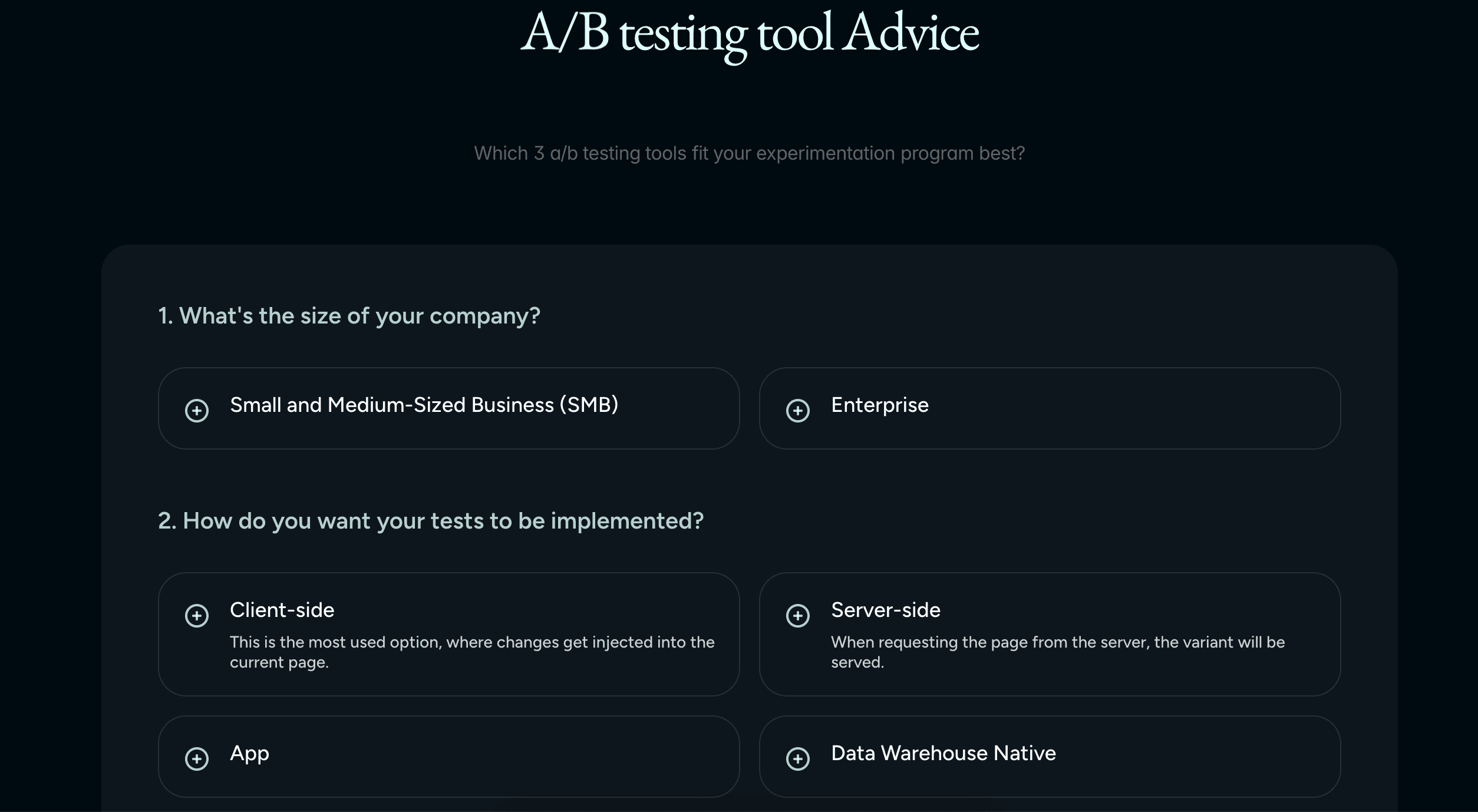
We’ve also developed our own A/B Testing Tool Advisor to help you find the best fit.
Step 1: Create a list of goals of experimentation
Before looking at any vendor's features, you must understand your internal needs.
Experimentation is a team sport, and successful implementation requires alignment across the organization. You need to identify what problems the tool needs to solve for every stakeholder.
Speak to teams across your organization (Product, UX, Marketing, Data, Development) and ask the following critical questions:
- Testing & Learning Potential: What specific hypotheses or features would they potentially like to test and learn from in the next 6-12 months? (E.g., Marketing needs personalized landing pages; Product needs new feature validation).
- Key Metrics: What are their top-3 most important metrics? Ensure the testing tool can easily integrate with your existing analytics to report on these metrics accurately.
- Past Experience & Future Vision: How have they used a testing tool in the past (what worked, what failed) or how would they like to use one now? This helps define required complexity and usability.
Define Technical Scope (Client-Side vs. Server-Side)
Crucially, determine the required scope of testing. Do you only need basic front-end (client-side) visual tests? Or do you need the capacity for deeper, more robust server-side experimentation (feature flagging, testing different backend logic and no flickering effect), and/or mobile application testing? Your technical requirements will drastically narrow the field of appropriate vendors.
Step 2: Create a top-5 of vendors by researching options
Once your requirements are clearly documented, it's time to assess the market. A broad search is necessary, but don't limit yourself to just the biggest players. Look for tools that specialize in your required methodology (e.g., server-side, app testing, or headless solutions). Create a top-5 list.
Some additional advice:
- Advice for your situation: Tools range widely in complexity and price, from lightweight free options to enterprise-level platforms. We’ve developed our own A/B Testing Tool Advisor to help you find the best fit.
- Leverage your network. Speak to other professionals or companies who have recently gone through this selection process. If your team lacks internal CRO experience, hiring an external experimentation consultant can save significant time and money by guiding you directly to suitable platforms.
Step 3: Plan 3-5 demos with vendors
Use your shortlist of 5 vendors and plan demos. Involve a small, dedicated team of decision-makers from the relevant departments (Development, CRO/Product, Data). In the demo you should ask about:
The QA Process and Reliability:
Can you use a staging environment or sandbox to see how the tool works? Is there a robust preview-mode to QA variants before deployment? How easy is test segmentation and verification?
Performance Impact and SEO:
Ask specifically about the tool’s impact on site performance (Core Web Vitals, page load speed), flickering effects (Flash of Original Content, or FOUC), and how the tool is implemented to minimize performance degradation.
User Management and Access:
Can everyone in the experimentation team easily access real-time data about running tests?
How is user management handled? Are licenses tied to specific seats, and how many users are included in the base package?
Use a Real-Life Example Setup:
Do not rely on the vendor’s canned demo. Present a realistic, slightly challenging use case, for instance, "We need to target only logged-in users who have abandoned a cart in the last 7 days." Ask the vendor to walk through the exact setup process in their interface to prove technical feasibility and ease of use.
Pricing Transparency and Volume:
Most testing tools charge based on the amount of traffic exposed to the experiments (Monthly Tracked Users, or MTUs). Get help to calculate this number realistically so you do not overpay.
An example:
If your website has 2 million monthly visitors, you probably won’t need to pay for 2 million MTUs. If you run 3 tests a month, you only pay for the visitors who enter those tests. Minimum Detectable Effect (MDE) calculations (we can help you do this if you contact us) to estimate the necessary sample size. The required volume is likely much lower than your total site traffic.
Step 4: Select the best one or two tools
After filtering the demos, you should have one or two strong contenders. This final stage is about deep-diving into specific solutions and verifying support quality.
Deep Dive and Sandbox: Plan one final demo focused exclusively on specific technical integrations or challenges identified in Step 1. Request access to a sandbox environment or free trial period to let your technical team truly play around with the implementation and SDKs.
Test Customer Support: Before committing, proactively send the vendor's customer support team a complex, non-standard question (outside of the demo setting). Assess their response time, knowledge, and quality of service.
Future Proofing and Scalability: Think long term. Is it easy to scale up the number of tracked users if your program expands? Is there a clear path to professionalize your program, perhaps moving from client-side to server-side testing, or incorporating mobile app testing features later?
Ask any final lingering questions that have come up during your internal discussions. Ensure the contract terms align with the calculated required usage volume determined in Step 3.
If you want a shortcut to finding the best options for your setup, try The Initial’s A/B Testing Tool Advisor. Answer a few quick questions about your company size, testing method, and must-have features, and you’ll get a tailored list of the top three tools that fit your program best.
See the testing tool in action here.
